A citizen science project by RWTH Aachen University
Donate your smart home’s electricity data to research
Your home often already knows when the heat pump kicks in, when the car charges, and what the solar roof produces. Exactly this knowledge helps researchers design tomorrow’s power grid. With a few clicks in Home Assistant you can contribute your data securely.
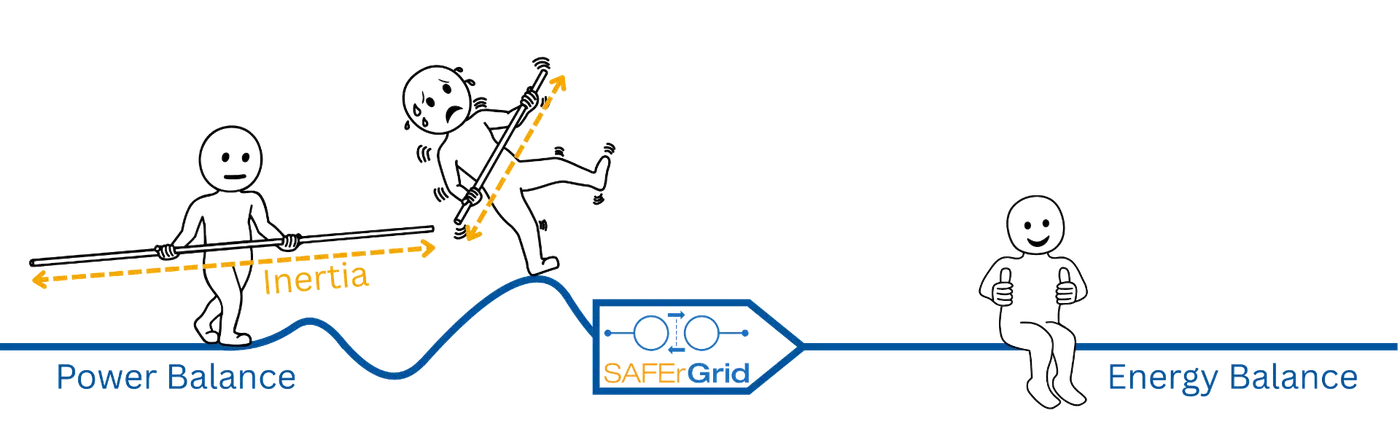
A power grid that works like the Internet
The power grid is facing its biggest rebuild in a century. Until now, a few large power plants have kept everything in lockstep: their heavy turbines act like a flywheel that absorbs every fluctuation. With solar, wind, and batteries, that flywheel dwindles, while electricity flows become more erratic and more local.
The SAFEr Grid research project therefore pursues an idea that has proven itself in the Internet: instead of one rigid whole, many grid sections that balance themselves and pass energy on to each other, much like routers pass on data packets. Four research groups at RWTH Aachen University and Aalborg University are working on the foundations, funded by a Synergy Grant of the European Research Council.
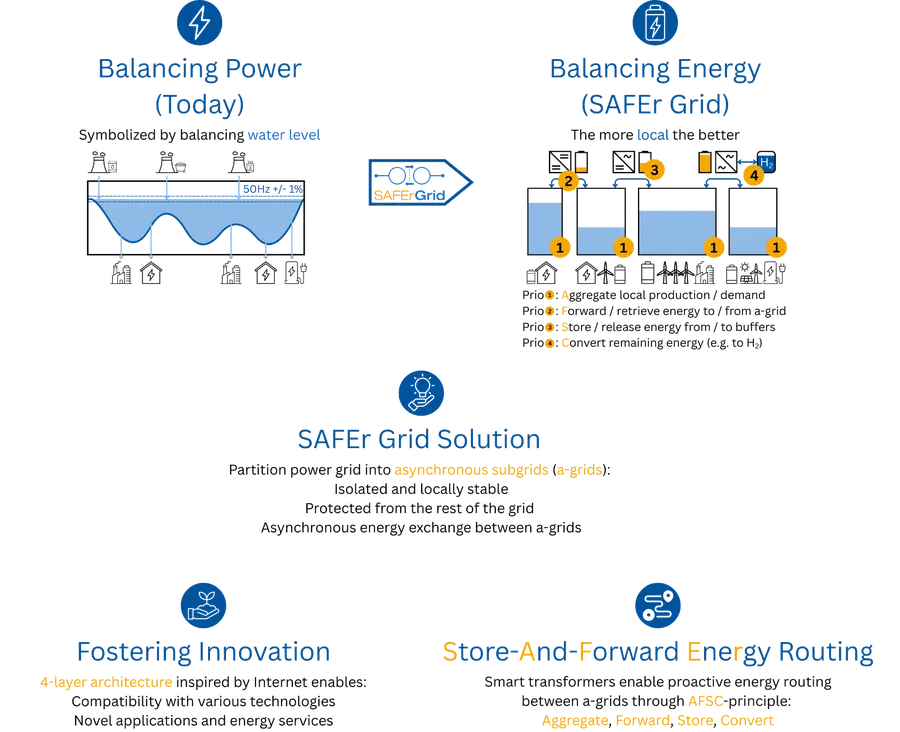
Why we need real household data
Whether such a grid stays stable is also decided in households: when thousands of EV chargers start in the evening, when solar roofs feed in at noon while nobody is home, or when people adapt their consumption habits to dynamic electricity prices. Before building a radically new grid, simulations help. But those simulations are only as good as the data they are fed with.
Synthetic load profiles capture the everyday life of individual households only coarsely, and they largely date from the era of large turbine power plants. The dishwasher after the garden party, the heating element in January, the vacation week in August: much of that is often already sitting in your smart home’s records. Donated, it makes the simulations realistic on which the future grid is tested.
A day of electricity decomposed into appliances
The data in question may look like as follows. A household’s grid connection point, next to two individual appliances. The sum curve contains the fridge’s regular consumption as well as a washing program in the evening. Recognizing and modeling individual appliances within the sum is one of the research questions behind the Datenspende.
Scroll to zoom, drag to pan, double-click for the full day. Sample data for illustration.
What you donate
If you run Home Assistant, it already logs how much electricity your devices use and produce. You only share what exists anyway, and you choose which devices take part.
What goes in
- Power and energy time series (for some devices also voltage and current) of the devices and household readings you approve, such as the heat pump’s daily curve or the solar system’s feed-in.
- The device type and the device details from your smart home (name, vendor, model), so researchers know what a curve represents: washing machine, EV charger, fridge.
- Optional, if you choose to provide them: postcode, country, number of people in the household, and construction year of the building if known. This helps us put the data into context.
What stays out
- Your name, address, precise location, and anything that would identify you directly.
- Cameras, microphones, presence and motion sensors. They are never read in the first place.
- No new hardware needed either.
How to participate
Install the integration
Add the Datenspende integration to your Home Assistant with a few clicks.
Review and consent
See exactly which devices and measurements would be shared, and choose what you are comfortable with.
Let it run
From then on, the data flows automatically in the background. There is nothing more to do.
Follow your contribution
The data portal shows your donated data, and you can label your devices there, which helps the research further.
Using openHAB, OpenEMS, evcc, openWB, or Shelly? These platforms are on our roadmap.
Read the guideThe donation in numbers
Donated datapoints over time
Last updated: …
What becomes of your data
An open dataset
Your donation becomes part of an anonymized dataset that we will publish openly and then keep up to date, so energy researchers worldwide can work with it.
Realistic grid simulations
Real household data lets future power grids be simulated as they would actually be used. That is the yardstick for whether the SAFEr Grid concepts hold.
Your own consumption in view
In the data portal you can explore your own consumption and production over time.
Open research
Methods, results, and the dataset itself are shared with the research community. Publicly funded means publicly usable.
Frequently asked questions
Is my data anonymous? What about my privacy?
Can I stop participating?
Can someone access my smart home through the Datenspende?
Why can I provide an e-mail address?
What does it cost, and what do I need?
Which platforms are supported?
Who can access the data?
What is the data used for?
Do I need to be a customer of a specific utility?
How much bandwidth and storage does it use?
Who is behind this?
How is this funded?
From our research
A selection of work related to the Datenspende and SAFEr Grid.
Semi-Intrusive Load Monitoring via Smart Plug Data Fusion for Robust NILM
J. Breyer, L. Pompe, K. Gützlaff, N. Bollwerk, M. H. Alizai, K. Wehrle
SIAM International Conference on Data Mining (SDM), 2026
Resilient low-inertia power systems through asynchronous energy balancing
S. Schwarz, S. Sahoo, M. Stoffers, P. Pollok, L. Pompe, A. M. Fibich, A. Kaharević, K. Wehrle, A. Monti, F. Piller, F. Blaabjerg
Nature Reviews Electrical Engineering, 2026 , doi:10.1038/s44287-025-00256-5
Easing the Conscience with OPC UA: An Internet-Wide Study on Insecure Deployments
M. Dahlmanns, J. Lohmöller, I. B. Fink, J. Pennekamp, K. Wehrle, M. Henze
ACM Internet Measurement Conference (IMC), 2020 , doi:10.1145/3419394.3423666